The self-custody problem nobody talks about honestly
If you've spent any time around Bitcoin, you've heard the phrase: not your keys, not your coins. It's a principle that Bitcoin's most committed holders swear by — and it's not wrong. Owning Bitcoin directly means holding your own private keys, which means no bank, no exchange, and no third party can freeze, seize, or lose your funds.
The problem is that self-custody is genuinely hard to do well.
You need a hardware wallet. You need to write down a seed phrase and store it somewhere fireproof, waterproof, and secure from family members who might accidentally throw it away. You need to understand what a seed phrase actually is. You need to not lose the device, not forget the PIN, and not make a single irreversible mistake during a transaction. Get any of it wrong, and your Bitcoin is simply gone — no password reset, no customer support line, no recourse.
For a certain kind of investor, this is fine. For most people approaching Bitcoin for the first time, it's a genuinely high barrier. And that's where Bitcoin ETFs come in.
What a Bitcoin ETF actually is
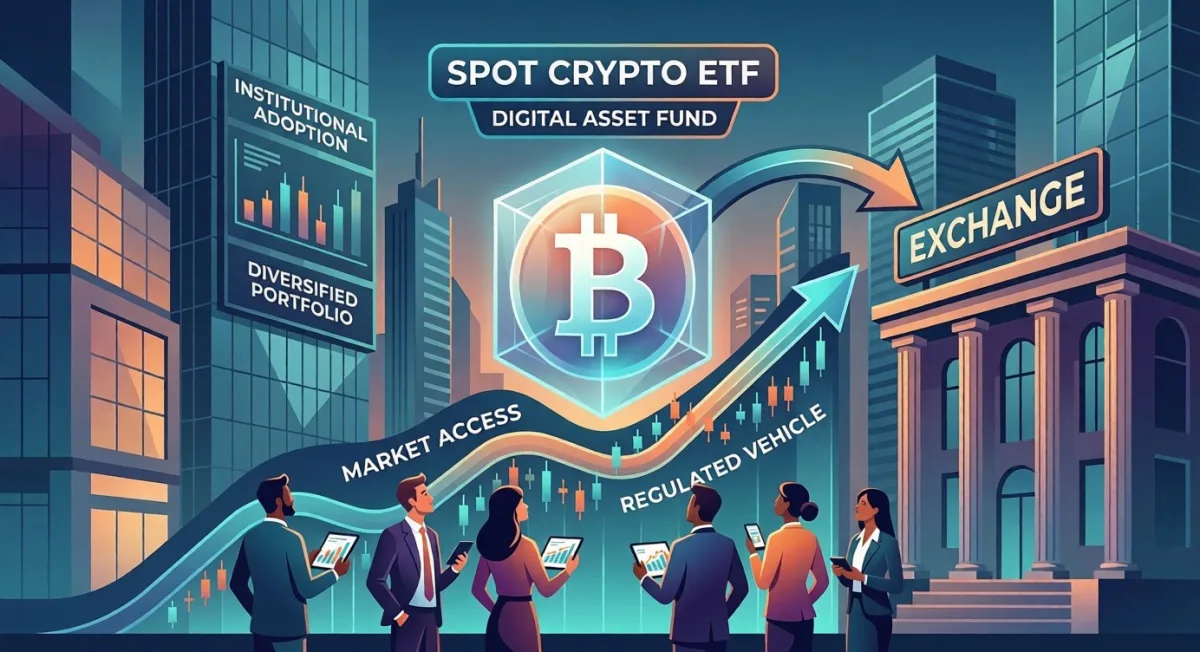
A Bitcoin ETF is a fund that holds Bitcoin on your behalf and trades on a traditional stock exchange — the same way you'd buy shares of Apple or an S&P 500 index fund. The price tracks Bitcoin's price closely. You buy through your regular brokerage account, and the ETF issuer handles everything else: custody, security, insurance, and regulatory compliance.
Spot Bitcoin ETFs launched in the United States in January 2024, and the market has grown significantly since. Cumulative net inflows reached $58.72 billion by May 2026, and U.S. spot Bitcoin ETFs reached the $100 billion AUM mark earlier in the year. Collectively, ETFs now hold over 1.4 million BTC — roughly 6.7% of the total 21 million supply — with BlackRock's IBIT ranking as the second largest Bitcoin holder of any entity in the world.
The real advantages
No custody risk on your end
This is the big one. When you hold Bitcoin directly, the custody risk sits entirely with you. One wrong move — a corrupted hardware wallet, a lost seed phrase, a phishing attack — and it's over. With a Bitcoin ETF, custody risk shifts to the issuer. Fidelity's FBTC, for example, custodies its own Bitcoin in-house rather than relying on third-party custodians, drawing on Fidelity's long track record in asset safekeeping. BlackRock's IBIT uses institutional-grade third-party custody. Neither approach is perfect, but both are considerably more robust than the average person's first attempt at running their own hardware wallet.
It fits into accounts you already have
Bitcoin ETFs trade on standard exchanges, which means you can buy them inside a brokerage account, an IRA, or a 401(k) that allows self-directed investments. Holding Bitcoin inside a tax-advantaged retirement account isn't possible with direct ownership, and the tax implications of doing it through an ETF versus holding coins directly can be significant depending on your situation.
Liquidity is immediate and familiar
Selling Bitcoin directly involves navigating an exchange, dealing with withdrawal times, and potentially triggering different tax events depending on how it's held. Selling a Bitcoin ETF share is the same as selling any stock — a few clicks, settled in your brokerage account within the standard timeframe. For investors who value simplicity and speed, this matters.
Regulatory protection
ETF issuers are regulated financial products subject to SEC oversight. That doesn't mean they're risk-free, but it does mean there are disclosure requirements, audits, and investor protections that simply don't exist when you're holding coins on a hardware wallet in your desk drawer.
The real disadvantages
You don't own the Bitcoin
This is the philosophical objection, and it's a real one. An ETF gives you price exposure — if Bitcoin goes up, your shares go up. But you don't hold the actual asset. In a true financial crisis or systemic failure scenario, the distinction between "exposure to Bitcoin" and "actual Bitcoin" could matter. The not your keys, not your coins argument exists for a reason.
That said, it's worth noting that at least one ETF issuer is actively giving back to the network it profits from. Bitwise has pledged to donate 10% of gross profits from its Bitcoin ETF (BITB) each year to open-source Bitcoin developers. In March 2026 they made their second annual contribution — $233,000 to Brink, OpenSats, and the Human Rights Foundation — bringing their total to $383,000 since launch. It doesn't change the philosophical argument, but it's a meaningful gesture from an issuer that understands where the value comes from.
Fees compound over time
Over long periods, a 0.25% annual expense ratio compounds into a meaningful deviation from Bitcoin's actual price performance. Holding Bitcoin directly has no annual fee. For long-term holders planning to hold for decades, this gap is worth running the numbers on before deciding. The lowest fee currently available among U.S. spot Bitcoin ETFs is 0.14%, offered by Morgan Stanley's MSBT — though it launched in April 2026 and lacks the track record of older products.
No yield, no on-chain utility
Holding actual Bitcoin opens doors that ETF exposure doesn't: native staking through protocols like Babylon, Lightning Network payments, participation in on-chain activity. An ETF share is purely a price instrument — it doesn't give you access to anything Bitcoin's network can actually do.
Counterparty risk doesn't disappear — it just changes shape
Self-custody eliminates exchange risk and custodian risk. ETFs reintroduce custodian risk and add ETF issuer risk. With IBIT holding a dominant share of total Bitcoin ETF AUM, there's a systemic consideration: if a single issuer encounters institutional or operational problems, the market impact could be significant. This is unlikely, but it isn't zero.
Who should consider a Bitcoin ETF
A Bitcoin ETF makes the most sense if you want Bitcoin price exposure but aren't ready to manage self-custody responsibly, want to hold Bitcoin inside a tax-advantaged retirement account, already have a brokerage account and prefer to keep everything in one place, or are investing a relatively small amount where the custody overhead isn't proportionate to the position size.
It makes less sense if you're a long-term holder who has time to learn self-custody properly, want to use Bitcoin's network (Lightning, Babylon, on-chain transactions), are philosophically committed to financial sovereignty rather than just price exposure, or are holding large amounts where annual fees become a meaningful drag over time.
The bottom line
Bitcoin ETFs aren't a compromise for people who couldn't figure out self-custody. For a specific kind of investor — cautious, already in a traditional brokerage setup, prioritising simplicity and regulatory familiarity — they're genuinely the right tool. The tradeoffs are real on both sides.
If you're curious about Bitcoin but the self-custody learning curve has been the thing standing between you and a first position, a spot ETF is a legitimate way through that door. Just go in clear-eyed about what you're getting, and what you're not.