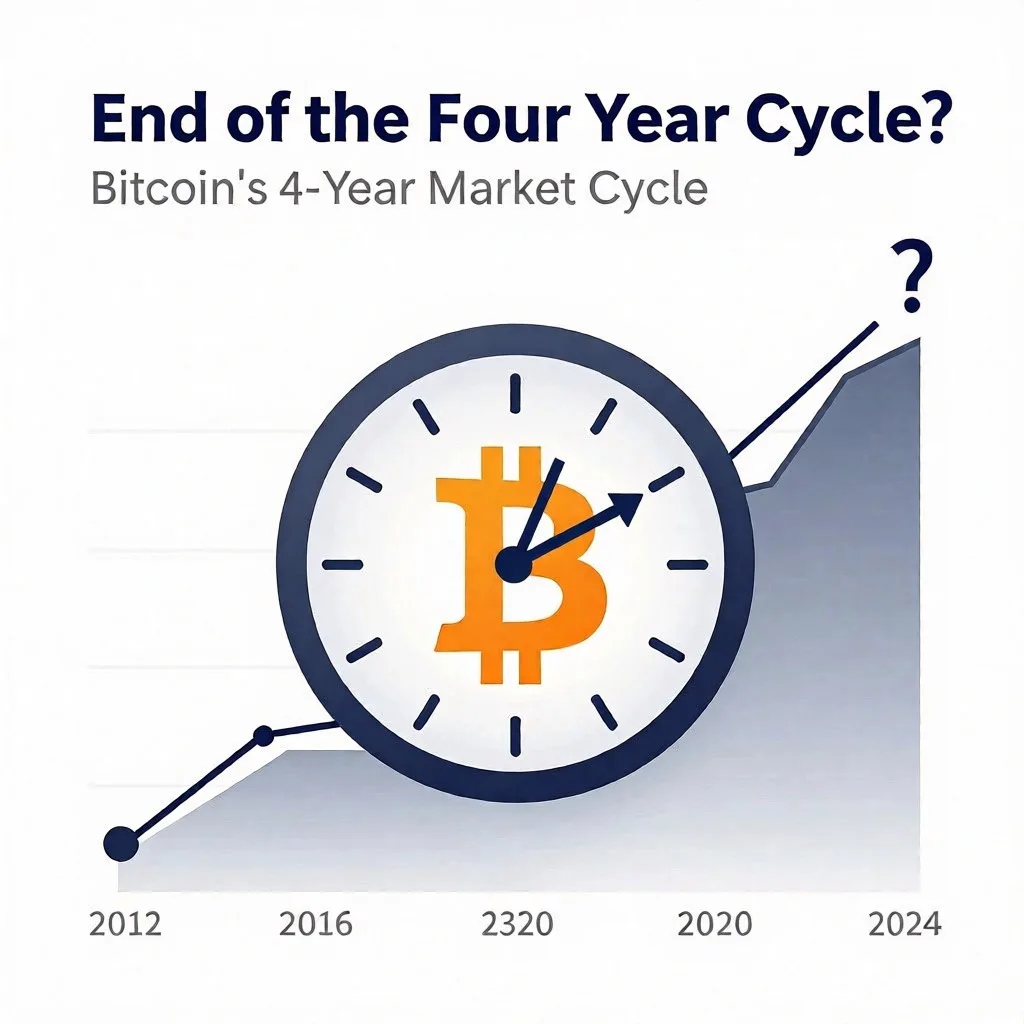
For years, Bitcoin investors have watched one pattern more closely than almost anything else: the roughly four-year halving cycle. The idea is simple—Bitcoin’s new supply gets cut in half, scarcity increases, demand eventually catches up, and the market enters another big bull run.
That story has fit Bitcoin’s history surprisingly well. But as Bitcoin becomes larger, more widely held, and easier to buy through traditional investment products, the old pattern may be getting less predictable.
The four-year cycle may not be dead. It may simply be growing up.
A Quick Refresher on the Halving
Bitcoin has a built-in supply schedule. Roughly every four years—or every 210,000 blocks—the number of new Bitcoin issued to miners is cut in half. This event is called a halving. Fidelity’s halving overview explains the mechanics in plain English.
The halvings so far took place in:
- November 2012
- July 2016
- May 2020
- April 2024
After the April 2024 halving, the block reward dropped from 6.25 BTC to 3.125 BTC. In other words, fewer new Bitcoin enter circulation each day than before. Fidelity Digital Assets describes the halving as a programmed reduction in Bitcoin issuance designed to preserve the asset’s long-term scarcity.
Historically, Bitcoin has often risen sharply after halvings. But “often” is not the same as “always,” and it does not mean a calendar can predict the next top.
The Big Gains Are Getting Smaller
Bitcoin’s early years were wild. When an asset is tiny, even a relatively small amount of new money can send the price flying.
Going from a market value of $1 billion to $10 billion is a major move—but it is far easier than moving from $1 trillion to $10 trillion. As Bitcoin has grown, repeating the spectacular 10x or 100x gains of its early days has become harder.
That does not mean Bitcoin cannot rise meaningfully. It means the math changes as the asset gets bigger.
A more realistic way to look at the history is this:
- Bitcoin’s early bull markets produced extraordinary percentage gains.
- Later cycles still produced major rallies, but generally smaller percentage multiples.
- A much larger market capitalization requires much more capital to create the same percentage move.
This is normal market maturity. A small startup can double quickly; a trillion-dollar company usually cannot double as easily.
The Crashes May Be Less Extreme
Bitcoin has always had brutal downturns. Earlier bear markets saw drawdowns of roughly 80% or more from peak to trough. That is part of why Bitcoin has been exciting for believers—and terrifying for everyone else.
The good news, if you are thinking long term, is that Bitcoin’s volatility has generally come down over time. It is still a volatile asset, and sharp drops remain very possible. But it is not quite the same tiny, thinly traded market it was a decade ago.
Fidelity Digital Assets has noted that Bitcoin’s volatility has declined over time, even though the asset can still move sharply in either direction. Its volatility analysis is a useful reminder that “less volatile than before” does not mean “low risk.”
There are a few possible reasons for this shift:
- More long-term holders are willing to sit through downturns
- Bitcoin is more accessible through major exchanges and brokerage platforms
- Institutional investors and wealth managers now have regulated ways to gain exposure
- Bitcoin is increasingly watched alongside interest rates, liquidity, equities, and the broader economy
Still, it is too early to say that Bitcoin now has a permanent price floor. Markets change quickly, and large holders can sell just as easily as they can buy.
ETFs Changed the Conversation
One of the biggest recent changes came in January 2024, when the U.S. Securities and Exchange Commission approved spot Bitcoin exchange-traded products for listing and trading. That made it easier for investors to gain Bitcoin exposure through familiar brokerage accounts rather than managing a crypto wallet themselves. A legal summary of the SEC’s January 10, 2024 approvals outlines why the decision was such a major milestone.
That matters because Bitcoin is no longer driven only by crypto-native traders, social-media hype, and retail speculation.
Today, price action can also be influenced by:
- ETF inflows and outflows
- Interest-rate expectations
- Stock-market sentiment
- U.S. dollar strength
- Global liquidity conditions
- Institutional portfolio rebalancing
- Regulation and political developments
This does not mean institutions are calm, patient buyers all the time. They can sell, hedge, rebalance, and react to risk just like anyone else. But it does mean Bitcoin is becoming more connected to the wider financial system.
So, Is the Four-Year Cycle Over?
Probably not—but it may matter less on its own.
Bitcoin’s halving still changes the supply of newly issued coins. That is a real part of Bitcoin’s design, and it has not gone away. But markets are more complicated now than they were in 2013 or 2017.
The next major Bitcoin move may be shaped by the halving, but also by ETF demand, global money conditions, institutional positioning, and the overall appetite for risk.
That makes the old “buy before the halving, sell at the peak, wait for winter” playbook much less reliable.
The Bottom Line
Bitcoin may be moving away from the simple boom-and-bust rhythm that defined its early years. Its percentage gains have generally become smaller as its market value has grown, and its market structure now includes regulated investment products, institutional buyers, and larger pools of capital.
But the evidence does not prove that the four-year cycle is dead.
A better conclusion is that Bitcoin’s cycle is evolving. Halvings still matter, but they now operate inside a much bigger world of ETFs, macroeconomics, liquidity, and investor behavior.
For anyone watching Bitcoin, that is the key takeaway: historical patterns are useful context—not a crystal ball.